
When to Buy Bakery Equipment (and What to Buy First) | Episode 6
Updated: Aug 13
Listen on Apple Podcasts
You are stuck at twelve loaves a bake day and you want to double it. Your dough is competing with the milk for space in the family refrigerator, your arms are tired from mixing by hand, and your home oven holds four loaves at a time so bake day stretches into the middle of the night.
Growing is exciting and also a little daunting, especially when the fix costs money you have not earned yet.
So let me walk you through how I make equipment decisions in my own microbakery, in the order I actually make them.
Find the bottleneck before you spend a dollar
As you grow, you start running into things that slow you down. Fridge space, oven capacity, storage space, manual processes. Every one can be fixed with equipment, and equipment is expensive, so the first job is figuring out which one is truly holding you back. Grab a pen and paper and answer these four questions.
Where are your production bottlenecks? Where does everything pile up and the day stops moving?
How much additional volume do you want or need to produce? Twelve loaves a bake day going to twenty four is a very different purchase than twelve going to eighty.
What is your budget? At your current capacity, what can you realistically afford to invest?
How much space do you have? If a mixer, refrigerator or oven comes through the door, where does it go?
There is a fifth question that matters just as much, and most bakers never ask it. How much can you afford not to invest?
If your oven is the limit and a different oven would double what you can bake, how fast would that extra capacity earn the money back? If you are mixing by hand for hours and a mixer would give you those hours plus more volume, how many bakes until it pays for itself? Write that number down.
The three big investments, and the order I would buy them
As bakers grow, three purchases come up over and over: a refrigerator, a mixer, and an oven. The order is a little subjective. Some people say fridge, oven, mixer. Others say fridge, mixer, oven. Notice the fridge comes first either way, and that is where I would start too.
Here is why. You can mix by hand if your body allows it, but you can mix far more dough than you can fit in your kitchen fridge, so you land right back in a bottleneck. A dedicated fridge or freezer for your proofing dough lifts that limit.
You do not need a brand new commercial unit. I went scrappy and bought a used upright freezer off Facebook Marketplace for $250, around twenty one cubic feet, and I can proof about eighty loaves in bannetons in it!
Because it is a freezer, I run it as a refrigerator using an InkBird temperature controller. The freezer plugs into the controller, the controller plugs into the wall, and I set my temperature there. When the inside creeps above my set point of 36 degrees, the cooling kicks on until it comes back down, then shuts off. It only runs a few minutes at a time, so it is efficient.
The part I love is that I can flip it back to freezer mode. If I load in a big batch of warm dough, I drop the temperature way down to chill it fast so nothing over proofs, then bump it back up and let it cold proof as long as I need.
Mixers and ovens
After the fridge, I bought a mixer. Mixing by hand had become a real production bottleneck, my days were not efficient, and the cleanup was wild. Now I mix twenty to twenty five loaves at a time instead of six to ten by hand. If you genuinely do not mind hand mixing, hold off and keep this one on your radar.
The oven is the big one, especially if you are still using your residential home oven. There are excellent dedicated bread ovens built for a home setting, like the Simply Bread Oven, the Rackmaster 2020 and the Rofco B40. They distribute heat beautifully, some have steam injection built in, and they save enormous time. If one makes sense for your business, go for it.
There are scrappy options too, and I took one. Back to Facebook Marketplace, where I found an older double wall oven, the kind built into cabinetry, for $250. I paid an electrician to wire the right outlet, and it doubled my capacity because I went from four loaves at a time to four per oven, eight total. It immediately improved my sleep, and I could offer more product at markets and to my porch pickup customers, which raised my revenue.
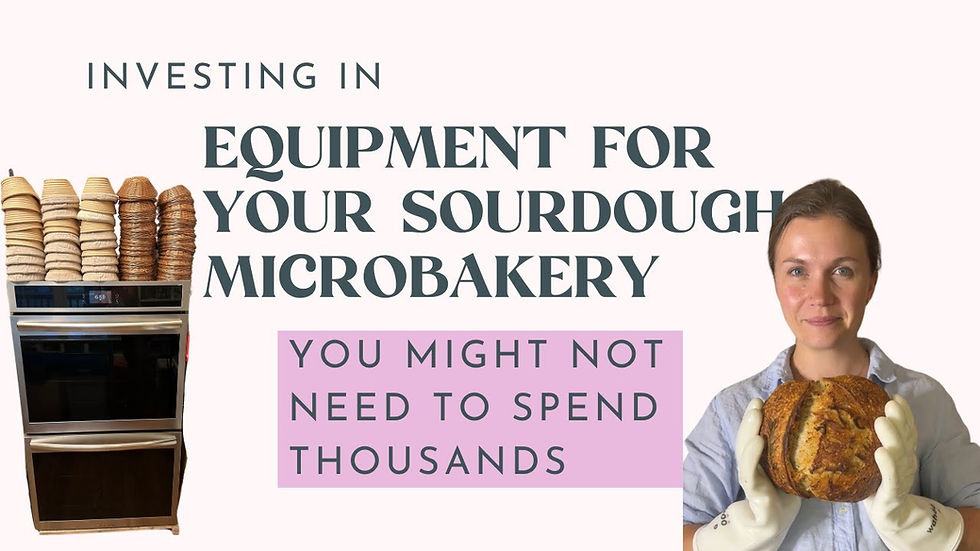
A few months later I did buy a brand new double oven, because the old one distributed heat so unevenly that two trays per oven meant burnt bread. The new one takes four loaves per steel and two steels per oven, so sixteen loaves at a time. It sits freestanding in the room next to my kitchen, raised a few inches off the floor on a wood pallet, and it works wonderfully. I am setting money aside for a real bread oven eventually, but this one runs about a third to a quarter of that price and I am happy here for a while.
The cheap fix most bakers skip
Storage is a smaller investment that solves a real bottleneck, so you can often do it earlier. Shelving, ingredient bins, cooling racks. As my production has grown, I have added cooling racks a little at a time, because bread with nowhere to cool stops the whole line.
Later on you can look at a dough sheeter, a proofing box or a speed rack. Those help, and they can wait.
How to buy used without getting burned
Used equipment is what let me grow when I did. If I had held out for brand new, I would have been stuck much longer saving up. Facebook Marketplace, Craigslist and the OfferUp app all have local listings worth watching. A few things I have learned the hard way.
See it in person and plugged in if you can, before it comes all the way home. We bought a double oven that had been stored outside. We picked it up in the drizzle, carried it inside, plugged it in, and the control panel was completely shorting out. Back it went, and thankfully we got our money back.
Ask how it has been stored and whether there are maintenance records.
Ask for flexibility on price unless the listing says the price is firm. Most sellers build a little room in. Offer slightly less, tell them you are ready to pick it up today with cash in hand, and consider bringing a fresh loaf of bread with you.
For research, the sourdough microbakery Facebook groups are genuinely useful. Search bread ovens in there and you will find real comparisons from people baking every week. Do not buy something because a big baker on Instagram has one. Buy the thing that makes sense for your family and your kitchen.
Paying for it, and protecting it
Once larger equipment lives in your home, think about maintenance and insurance. I am not an insurance expert, so do your own research there. What I will say is to set aside a little money at a time so an unexpected repair does not wipe you out.
Financing is a personal call. Some bread ovens offer it, which gets the oven in the door sooner and lets the extra capacity pay it off. Others bootstrap and pay cash, which is the route I have chosen. There are also loans and, in some areas, small business grants your chamber of commerce may know about.
Growing slowly is completely okay.
If you are a year or two in, do an equipment audit
If you are already running real volume, walk one full bake day with a notebook. Write down every point where you stood and waited or where product had nowhere to go, note the minutes each one costs, then multiply by bakes per month.
Price the fix for the worst one and divide by the monthly revenue that extra capacity would let you sell. That number is your payback period, and it turns a scary purchase into a math problem.
Then plan the space before the thing arrives. Make sure the workflow makes sense, the oven door can open fully, the flooring is easy to clean, and clutter is not creating a safety hazard.
Final thoughts
Assess your needs, prioritize your purchases, and do real research. Most of you will land on a fridge first, then an oven or a mixer, and the used market is what makes that timeline possible years earlier than saving for new would.
My $250 freezer and my $250 oven built the capacity this business runs on. Yours can too!
Cheering you on,
Caroline
Keep going
If this got you thinking about what is slowing your bake day down, these will take you further.
Links to things you might like!
Listen to this episode on Apple Podcasts: https://podcasts.apple.com/us/podcast/6-investing-in-equipment-is-it-time-to-level-up-your/id1753979437?i=1000662992656
The Bread Winner Inner Circle opens twice a year to a small group of bakers. Get on the waitlist to hear first when doors open: https://www.carolinebower.com/innercircle
Download the FREE guide and checklist, Your First Steps to a Successful In-Home Bakery, at https://www.carolinebower.com/checklist
Grab the Profit & Pricing Calculator: https://carolinebower.com/calculator to simplify the math, clarify your margins, and price your products with confidence
Join my email list: https://carolinebower.myflodesk.com/newsletter
Find all of my sourdough microbakery favorites, including packaging, pans, and bins, here
Follow me on Instagram (@carolinebower_sourdough) for more microbakery tips: https://www.instagram.com/carolinebower_sourdough


Comments