
My Best and Worst Microbakery Equipment Investments | Episode 43
Updated: Jul 30
Listen on Apple Podcasts or watch on YouTube
I was organizing the shelves in my bakery a while back and found a small museum of money I wasted. Oven gloves I used twice. A stack of muffin boxes I am still slowly working through. Green carry-out bags from my very first market that I still own almost all of.
Every one of those was money that left my business and never came back to me as revenue. Buying equipment for a microbakery is a business decision, and it deserves the same thinking you would give to your pricing or your menu.
None of this is here to shame my past self or to make you feel bad about whatever is gathering dust on your own shelf. When we know better, we can do better, and I would love for you to skip a few laps of the learning curve I already ran.
The two mistakes underneath every bad purchase I made
When I listed everything I bought and barely used, the same two things showed up. I reached for the cheapest option every single time, and I was buying in a hurry because I had not planned far enough ahead to have a choice. When you are shopping against a deadline, you are not choosing the best tool for your bakery. You are choosing whatever can be on your porch by Thursday at the lowest price.
What the cheapest option really charged me
Knit oven gloves labeled heat resistant. Within a couple of uses I was burning my fingertips straight through them. I use Lanon silicone gloves now, which leave you some dexterity and extend up your wrist so you stop collecting baker burns on your forearms.
A glass spray bottle for misting loaves. It shattered on the floor within three days. I love glass at home, and in a bakery where you move things constantly, food safe plastic is the better call. That same season I moved my starter out of glass mason jars into plastic Cambro containers.
Two dozen cheap nonstick loaf pans. Fine for a couple of months, then the black coating started transferring onto my bread. That is a hard no when you are selling to somebody's family. Stainless steel replaced them.
Muffin boxes that assemble like origami. The keyword you want when shopping for boxes is auto pop-up. Those are already glued in the right places, so you open them, fold the sides out, and you are done.
Little square Rubbermaid containers as banneton alternatives. Five for four dollars at Walmart, which felt very clever. Solid plastic does not breathe, so when I snapped the lids on to stack them I trapped the warmth inside and the dough over proofed badly. Silicone loaf pans did the same. I use plastic wicker bread baskets now, which are inexpensive, breathable, dishwasher safe, and do not grow mold the way my real wicker bannetons did.
Parchment loaf pan liners with no reviews. Large quantity, low price, overnight delivery. They stuck like glue to a whole bake of sandwich loaves and I had to cut them off the bread. I refunded every one of those customers, and a different brand solved it immediately.
Thin compostable carry-out bags for my first market, which just looked tacky on my table, and a cheap probe thermometer that broke within a couple of weeks.
Look at that liner story as an owner. The real price of that box was the liners, plus the flour, plus my labor, plus a full round of refunds, plus trust I had to earn back.
The planning habit that fixed most of it
The purchases I regret were nearly all rush purchases, so the fix sits upstream of the shopping. I now know a week or two ahead what is going on my menu and what packaging it needs, and I keep a small go-to set that covers every product I sell. It got small through trial and error, because I weeded out the bags that tear, the lids that will not stay on, and the boxes that take four minutes each to build.
If you do nothing else today, build that list. One page, one product per row, one reorder link each.
The small tools I reach for every bake day
If someone asks what to get you for your birthday, send them this list and say any of these, please!
A good bench scraper. Solid wooden handle, one straight piece of metal. Dividing dough, cutting scones, scraping counters clean.
Cambro containers. I keep a small amount of starter in a one quart container through the week, then feed it up to 300 grams before a bake. That goes into a twelve quart round Cambro with 3000 grams of water and 3000 grams of flour, and twelve to eighteen hours later I have the 6000 grams I need. I started with exactly one four quart container and added more as the business grew.
A lame you enjoy using. Mine is from Wire Monkey, and plenty of bakers I know are happy with the ones they found online. Before I owned one I held a bare blade and cut myself more times than I want to admit.
Restaurant Depot beats online pricing on Cambros and dough bins by a wide margin, and you can walk in on a free day pass. The other benefit of plastic is that when you drop it, it bounces instead of putting glass shards in your starter!
The medium investments that removed a real bottleneck
A high capacity scale. Most of us start with the small food scale that fits in a drawer, and it works right up until the day your bin is half full of flour and the display flashes an E at you. My main scale has a big flat metal surface, so my bins fit and I can preshape right on it. I later added a much cheaper second one that I knew would not last, because my assistant and I sharing one scale had become a bottleneck. Buying cheap is a fine decision when you can say exactly why you are doing it and what you are giving up.
A thermal printer. Mine is a Rollo. It runs on heat instead of ink, the labels are inexpensive, and there is no app to fight with. I design labels in Canva, download them as a PNG, and print straight from my laptop. If labels are a slow spot in your week, this pays for itself fast.
Stainless steel loaf pans. Twenty four of them is a real number, so buy six or eight at a time until you have your set. I cold proof sandwich loaves right in the pan with a parchment liner and put the whole thing in the oven.
The big ones, and how I actually paid for them
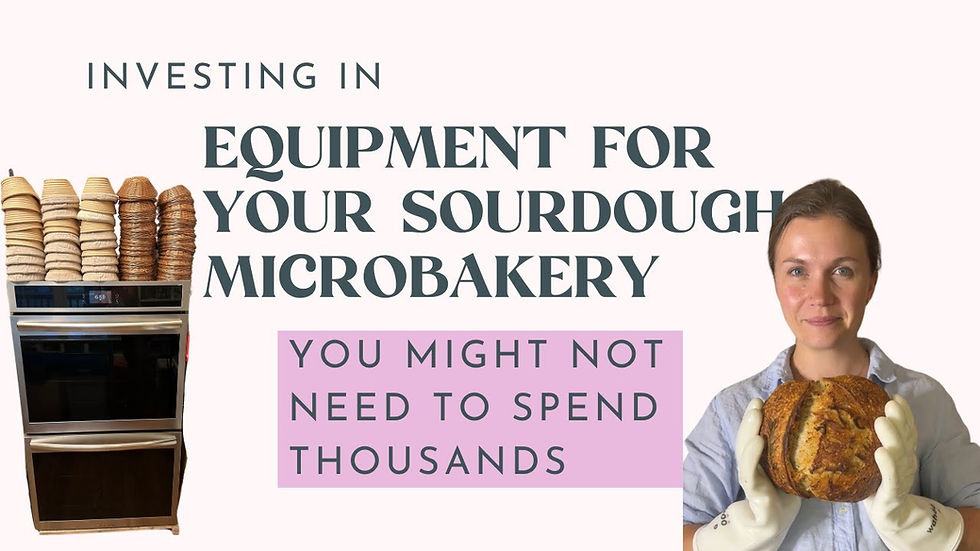
A double oven. My first six months were fourteen to sixteen hour bake days out of my home oven, and the oven was obviously my bottleneck. I started with a very inexpensive used double oven from Facebook Marketplace, then upgraded to a new model a few months later. I chose it over a proper bread oven because it was the entry point I could reach without financing a big piece of equipment. I will need a real bread oven eventually, since running a residential oven at 450 degrees for five hours at a stretch is not what it was built for, so I am budgeting for that slowly. If your oven setup allows it, the method I use is in the pinned reel at the top of my Instagram reels tab.
Baking steels. Two per oven, four total, four loaves on each. That is sixteen loaves at a time out of a residential double oven. It takes some shuffling to get the steam right, and it turns out gorgeous bread.
A second fridge. Mine is an upright freezer off Facebook Marketplace that I run as a fridge with an Inkbird temperature controller. When I load a lot of warm dough in, I crank it down to cool everything fast, then bump it back up for the overnight cold proof.
A speed rack. Also called a bun rack or a baker's rack, it is a rack on wheels with ten to twenty levels for sheet pans. I proof on it under a plastic cover, then swap the racks over on bake morning and cool everything on it. Much smaller footprint than the shelving it replaced.
An equipment audit for the operator a few years in
If you already have revenue coming in and a shelf full of gear, spend twenty minutes on this.
List everything you bought in the last twelve months and used fewer than five times. Look for the pattern. Mine was always cheapest plus rushed.
Name your current bottleneck out loud. Oven space, fridge space, cooling space, labels, or the scale you and your helper keep waiting on. Buy against the bottleneck, not the wish list.
Give equipment its own line in your monthly numbers, so the bread oven is something you save toward instead of something you finance in a panic.
Final thoughts
Nearly every purchase I regret came out of a decision I made twenty minutes before I needed the thing. The tools on my best list are the ones I chose on a calm day, for a problem I could name.
You will still buy a few duds. I did, and I probably will again. Give yourself the same grace I am giving my past self, take the lesson, and make the next purchase a more deliberate one.
Cheering you on,
Caroline
Keep going
If this got some wheels turning about what to buy next, these three will help you think it through.
Links to things you might like!
Listen to this episode on Apple Podcasts: https://podcasts.apple.com/us/podcast/43-learning-the-hard-way-my-worst-sourdough/id1753979437?i=1000679336884
Watch this episode on YouTube: https://www.youtube.com/watch?v=3aFmJg6u94U
The Bread Winner Inner Circle opens twice a year to a small group of bakers. Get on the waitlist to hear first when doors open: https://www.carolinebower.com/innercircle
One-on-one coaching is not currently available, but here is the next best thing: Coached by Caroline is a personalized 60-day plan built from your answers and everything I teach: https://plan.carolinebower.com
Find all of my sourdough microbakery favorites, including packaging, pans, and bins, here
Download the FREE guide and checklist, Your First Steps to a Successful In-Home Bakery, at https://www.carolinebower.com/checklist
Grab the Profit & Pricing Calculator: https://carolinebower.com/calculator to simplify the math, clarify your margins, and price your products with confidence
Try Sunrise Flour Mill organic heritage flour and take 20% off: https://thebreadwinner.captivate.fm/sunrise20
Join my email list: https://carolinebower.myflodesk.com/newsletter
Follow me on Instagram (@carolinebower_sourdough) for more microbakery tips: https://www.instagram.com/carolinebower_sourdough



Comments